
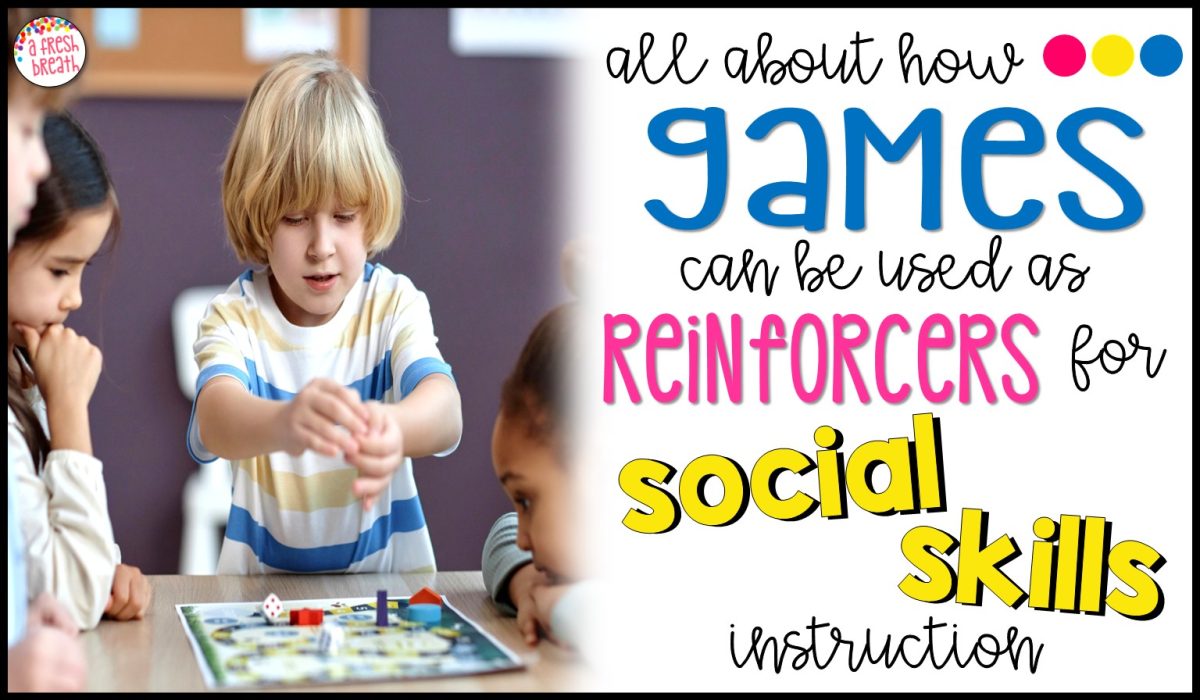
Games can be used as reinforcers for social skills when students need motivation to practice behaviors that don’t always come easily—like turn taking, cooperation, and flexibility. If you’ve ever planned a solid social skills lesson only to watch students lose interest halfway through, you’re not alone. Many students need repeated, structured practice to build social skills, but traditional instruction doesn’t always keep them engaged.
That’s where games come in—not as a reward without a purpose, but as a strategic reinforcement tool that encourages students to use their social skills in meaningful ways. When used intentionally, games can increase motivation, reduce problem behaviors, and create natural opportunities for students to practice social interactions.
In this post, you’ll learn how to use games as reinforcers, which types of games work best, and practical strategies for implementing them during social skills instruction.
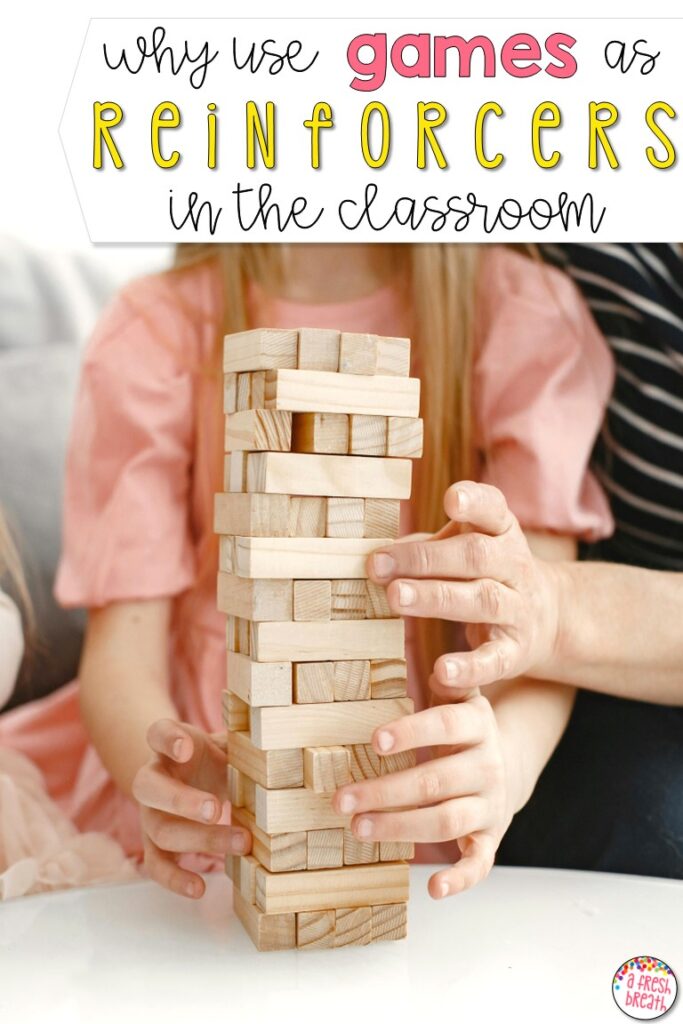
Why Use Games as Reinforcers in the Classroom?
In this case, a reinforcer means being used after direct instruction takes place. After everyone has the same basic knowledge of the concept, games can be used to practice and help generalize that learning.
Games are effective for so many reasons. They:
✮ increase engagement
✮ reduce behavior challenges
✮ encourage repeated practice of social skills
✮ can be used to tackle a wide range of different social emotional concepts
✮ work for all different kinds of students regardless of whether their reading or math levels are the same
Instead of relying only on tokens or worksheets, games are great social skills reinforcement activities because they are naturally motivating and interactive. Students are often willing to work harder when they know a preferred game is part of the lesson.
How to Use Games as Reinforcers in Social Skills Instruction
When using games in social skills, there are 4 main steps that you can follow for successful social skills instruction.
Step 1 – Identify the Target Social Skill
Are you working on taking turns? Or maybe cooperative play? How about sharing? Depending on what skill you want to focus on, that will determine which game you want to play as well as how it is played.
Clearly identifying what social skill you are working on is an important first step when using board games to teach social skills.
Step 2: Teach the Skill Explicitly First
To make sure your students are successful, make sure they really understand the skill they are working on first. Giving direct instruction before teaching social skills through games is an ideal way to do this. That way, everyone is clear on what the skill means and how it looks.
Then, practicing the skill by first modeling it and then having students role play using the skill is a great way to get everyone on the same learning page before playing a game.
This will ensure that students are ready with their understanding to use games as a reinforcement activity.
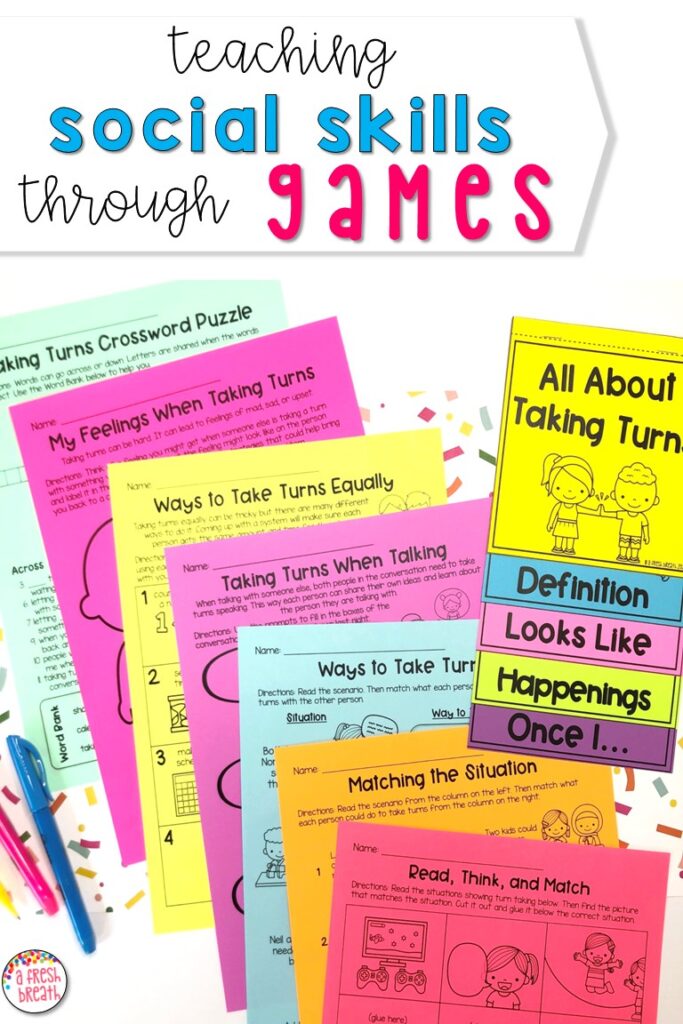
Running low on time to create your own lesson? Then check out this bundle of lessons (with activities) on all sorts of basic social skills topics. This includes following directions, sharing, turn-taking, listening, following rules, working with others, patience, and more! You’ll find each topic has a 2 page lesson plan for direct instruction with a corresponding activity. Plus there is a list of extension activities, 2 sets of task cards for each concept, and 10+ worksheets to reinforce the concepts. Grab this 500+ page teaching resource for some great direct instruction with multiple activities to reinforce learning so you can get to the fun part of playing games! Click here for the bundle of basic social skills lesson plans, activities, and teaching resources!
Step 3: Use the Game as the Reinforcer (Not the Lesson)
Think of the games as social skills reinforcement ideas for elementary students. It is not when you are teaching the skill, but when practicing the skills.
You can even use this as an earned activity. Tell students that they can earn playing a game by showing appropriate and expected use of whatever skill they are working on. For example, if they are working to learn the skill of sharing, after giving direct instruction on the concept and having students practice it during the lesson, use a game that allows them to practice sharing. This gives more opportunities to generalize their learning.
Step 4: Set Clear Expectations
Right before game play, make sure to review behavior expectations first. This can be simple things like which order game play is happening and how taking your turn looks. It can also be having good sportsmanship so there are no mean words said that hurt feelings.
Also make sure while playing the game to reinforce positive behaviors. This can be both for students showing expected behaviors while playing any game (turn taking, kind words, staying with the group, etc.) as well as the social concept being worked on. So if you are working on patience, point it out when you see it. Simple things like “I like how Sarah is being patient by sitting on her pockets when it isn’t her turn” or “Sean is showing patience waiting for the dice” are helpful for students to notice the skill they are working on in action.
Best Games to Reinforce Social Skills
There are three main types when it comes to the best games to reinforce social skills:
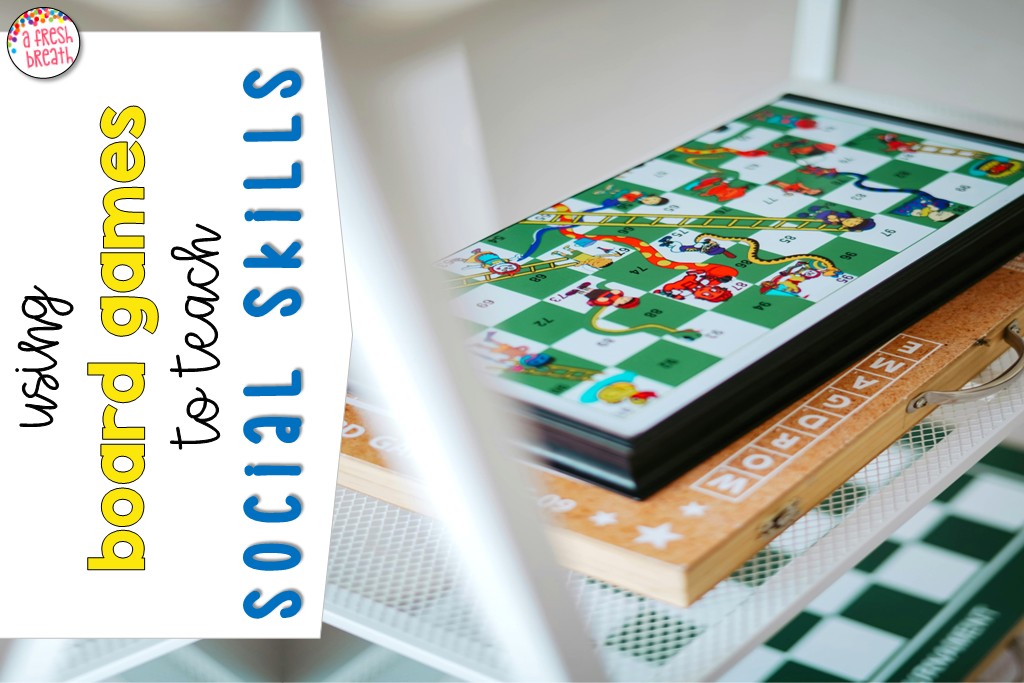
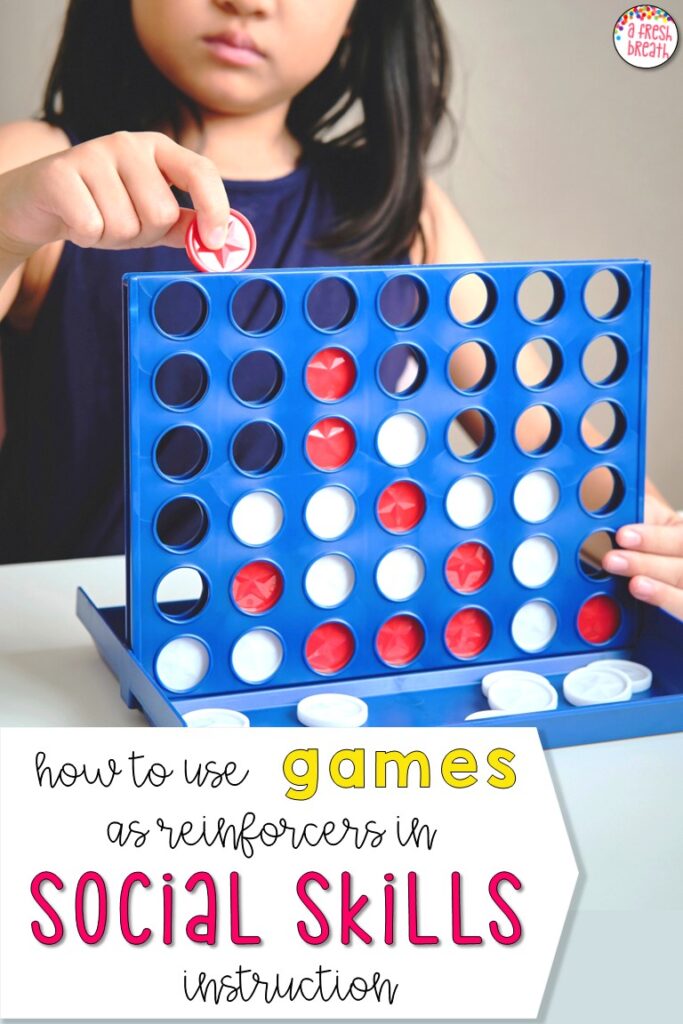
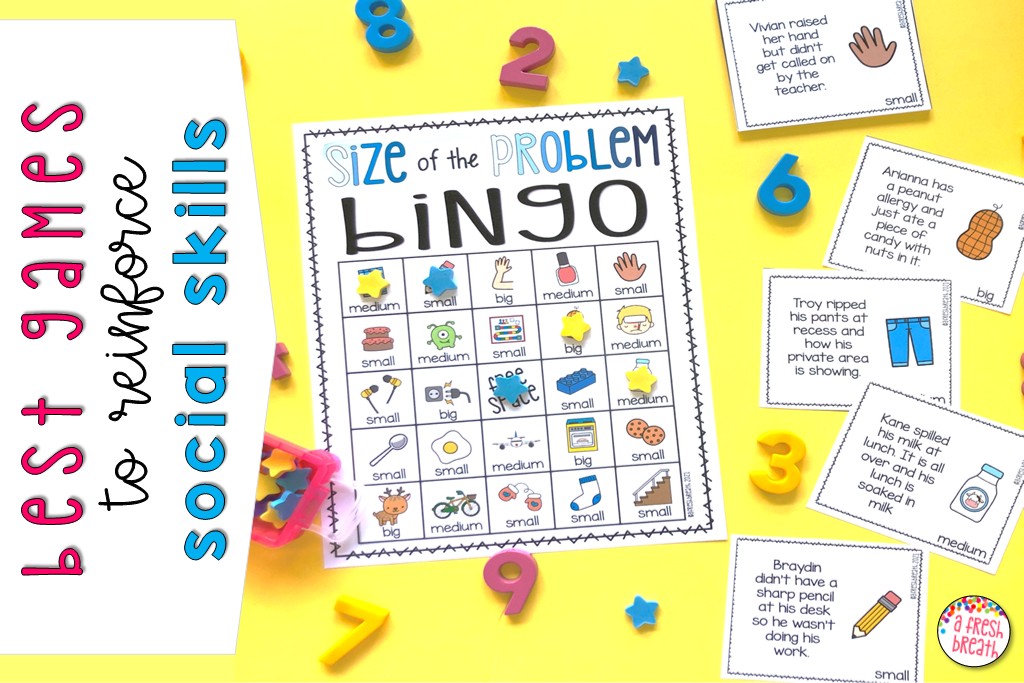
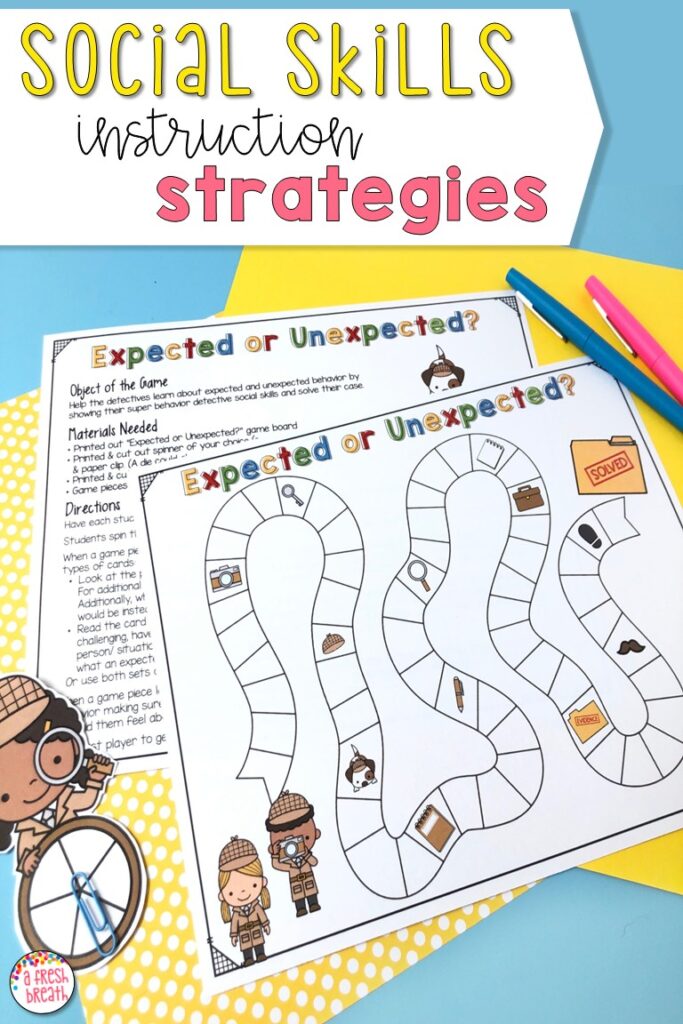
✮ Board games – these promote turn taking, patience, and rule following. Some great common examples of different board games are: Sorry!, Trouble, Sequence for Kids (there is a great math version of this game too!), and Connect 4. And don’t forget that there are specific games you can get just for teaching social skills. For instance, The Zones of Regulation has their own board game and you can find some fun Bingo games about different topics like Size of the Problem or Flexible Thinking (pictured below).
✮ Card games – these are great for encouraging flexibility and good sportsmanship. Plus they are super easy to adapt to small groups or when a student is in a 1-on-1 setting. Some examples of these are: Uno, Go Fish Spot It!, and Old Maid.
✮ Digital games – these are highly motivating for many students due to their digital nature. Pro-tip if using these: make sure to set clear expectations and time limits before playing them. Some of my favorite digital games are on Boom Learning. You can find more about Boom Learning and how digital task cards look game like here.
Games That Reinforce Turn Taking and Cooperation
Turn taking and cooperation are foundational social skills because they show up everywhere: classroom centers, recess, group projects, line-up time, board games, partner work, and even casual conversations. If students can’t wait, share control, or work with peers, everything else becomes harder.
That’s why games can be used as reinforcers for social skills so effectively—because games naturally create moments where students must practice these exact skills.
So what makes a good game for turn taking and cooperation?
✮ Students must wait to play – waiting is one of the most challenging social skills for many students. A game that includes natural “waiting turns” creates repeated practice opportunities.
✮ Players share materials or space – games that involve shared pieces, cards, or a common board create built-in opportunities for sharing, asking, and respectful behavior.
✮ Students have a reason to help peers – cooperative games, partner games, and team-based games encourage students to support each other instead of focusing only on winning.
If you are looking for some great cooperative games (those where students have to work together towards a common goal where either everyone wins or everyone loses), check out “Count Your Chickens” and “Gnomes at Night.”
Looking for More Social Skills Instruction Strategies?
Check out these blog posts for more on social skills instruction with games:
3 Engaging Teaching Feelings Games – Here you’ll find ideas for teaching all about emotions in interactive ways.
How to Help Students Think Flexibly With Games – Work on the important social emotional skill of flexible thinking with these games.
How to Use Boom Cards to Increase Engagement – You’ll find more on digital task cards and understand why students see this as a digital game (while they are actually learning!).
Games are more than a break from instruction—they can be powerful tools for reinforcing social skills when used with purpose and structure. When students know that appropriate behavior, effort, and participation lead to something motivating, they are more likely to stay engaged and practice important skills. By setting clear expectations, choosing developmentally appropriate games, and using them consistently, teachers can successfully show that games can be used as reinforcers for social skills instruction in meaningful ways.
Whether you’re working with small groups, whole-class lessons, or individualized supports, games offer a flexible and effective reinforcement option that helps students build social skills while having fun.
Happy Teaching!


